

Google is no longer the only — and increasingly not the primary — way potential customers find a trade business. People ask ChatGPT for bathroom fitters in their area. They ask Claude. They ask Gemini-inside-Google. They ask Perplexity for ranked lists. The shape of the search query, and the shape of the answer, are both changing.
Two surfaces, two strategies
Classic Google SEO is largely solved-by-now: schema markup, fast Core Web Vitals, real local citations, location-page architecture, fresh content. We do all of that as part of any build. It is not the differentiator anymore.
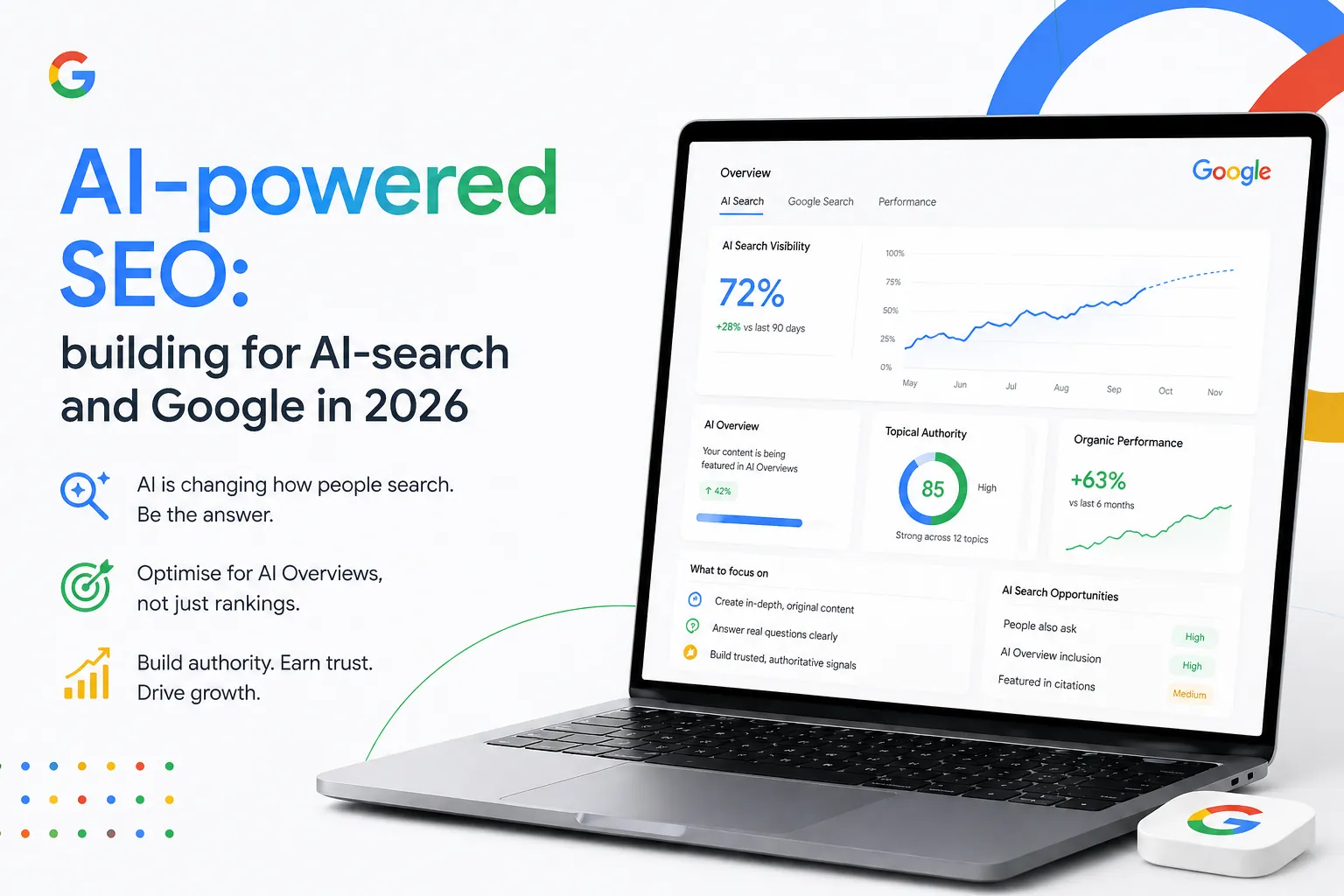
AI-search is different. The AI is going to read your site and form a structured opinion: who you are, where you operate, what you charge, what kind of jobs you take. If you do not make that easy to extract, you do not exist in AI-answers. Easy to extract means: explicit FAQ pages, structured pricing, schema for services and locations, named team members with credentials, real reviews exposed in machine-readable form.
The AI-extractable site
- , A clean services list with one URL per service.
- , A locations list with one URL per area.
- , An FAQ page that uses real customer questions, not generic ones.
- , Pricing visible — even just a floor — in plain text.
- , Reviews exposed with full names and dates.
- , Schema.org markup for Organization, LocalBusiness, Service, FAQPage, Review.
What we are seeing in practice
On a London bathroom client's site we added structured FAQPage schema in week 4 of January. By March, the site started appearing as a cited source in Perplexity answers for 'bathroom renovators West London.' We have not seen it cited in ChatGPT yet, but ChatGPT's web index is more selective. Bing-indexed pages with rich schema appear to be the most likely to be cited.
The compounding effect
AI-search traffic, where it does materialise, converts higher than Google traffic. The visitor has already had the site described to them by an AI. They arrive pre-qualified. We are seeing 2-3x conversion rates on AI-referred sessions versus organic Google sessions, on the small set of clients where we have enough data.
The way to win AI search is the same way you win Google: be the most useful, most legible source. The legibility just has to be a level deeper now.
Luca Planchais
We rebuilt our own SEO setup at the start of 2026 to ship every site with FAQPage schema, LocalBusiness schema, Service-per-location URLs, and structured pricing. Two of our last five clients have already shown up in AI-search answers within six weeks of launch. This is the new floor.