






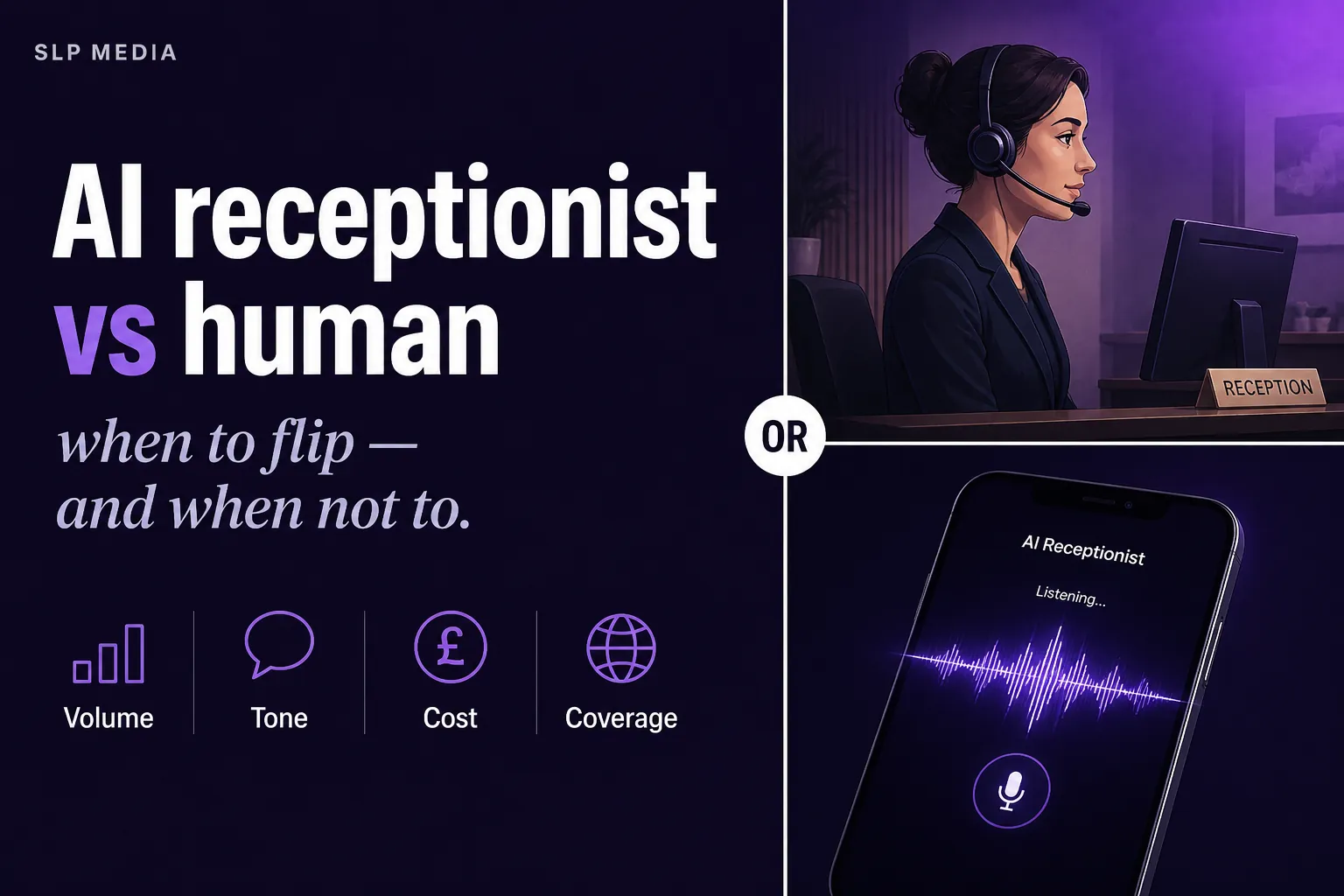
AI voice receptionists got across the believability line in 2025. The current generation handles bookings, answers FAQs, takes messages, and routes correctly about 90% of the time. The other 10% is where it gets interesting and where the decision lives.
What the current generation actually does well
Pick up on the first ring. Always. Never grumpy. Never on lunch. Never forgets to ask the postcode. Books straight into the calendar. Texts a confirmation. Logs the call to the CRM. Pulls the right answer to common questions ('do you do bathrooms in Bristol', 'how soon can someone come out', 'do you do free quotes').
For a trade business getting 5-30 calls a day, the AI version of this is roughly £75/month plus a small per-minute cost. A human doing the same job — even part-time — is £1,500+/month. The economics are not close.
What it still does badly
- , Heavy regional accents — Geordie, Glaswegian, deep West Country — still trip it up
- , Customers who are angry or upset want a human, fast
- , Anything requiring real judgement — discounts, custom quotes, scheduling around an emergency
- , Background noise — building site calls drop the recognition rate
- , Questions about the owner specifically (where is John, can I speak to John)
The flip test
We use a simple rule with clients debating this. Flip to AI if all four are true: you take more than 50 calls a month, the average call is under 3 minutes, more than 70% of calls are routine bookings or FAQs, and you have a clear escalation path to a human for the other 30%. If any of those is not true, stay human or do hybrid.
The hybrid model that almost always wins
AI takes the call. Routine stuff resolves on the call. Complex stuff gets a 'we will have someone call you back within the hour' and a real human handles those. This pattern — AI front door, human back office — is where most trade businesses end up. The cost is the £75/month for the AI plus a fraction of a human's time on follow-ups, instead of a full receptionist salary.
When NOT to flip
Three scenarios. First: high-touch bespoke trades where the call itself is part of the relationship — bespoke joinery, high-end interior design. Customers expect a human and judging the relationship from the first call matters. Second: emergency-led trades — emergency plumbers, locksmiths — where every call is a stressed customer at 2am. Third: trades where the average job is over £50k and every call is high-stakes. In all three, keep humans on the phone.
The AI receptionist is not the cheap version of a human. It is a different product. It wins on speed and consistency, loses on judgement and warmth. Pick by what your customers need on call one.
Seb Planchais
We deploy our Voice AI Receptionist as a £1,200 setup plus £75/month. Most clients run it in shadow mode for two weeks, where it answers but a human reviews every call transcript. After that, almost nobody turns it off.