







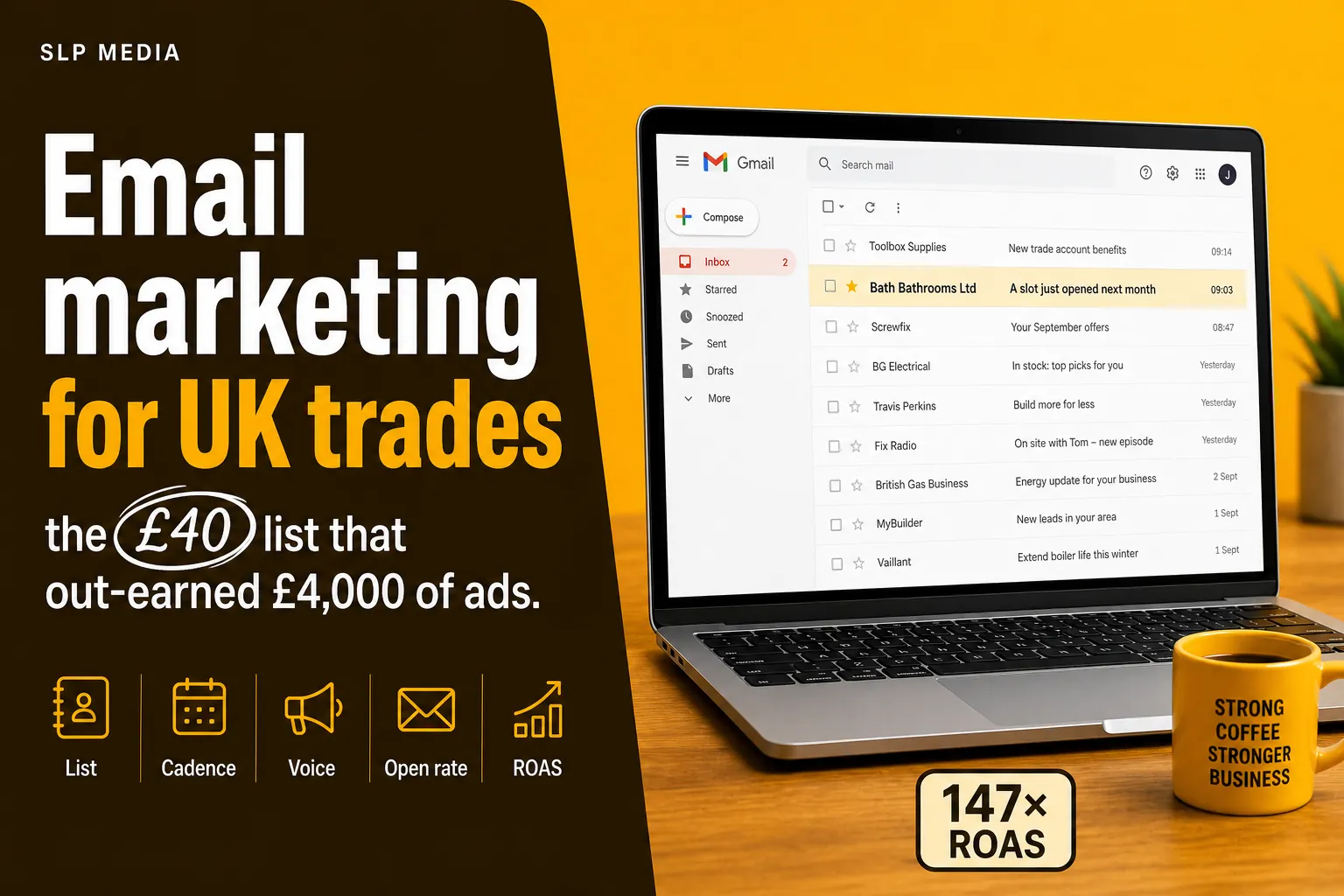
A renovation client of ours had spent £4,200 on Meta ads last March and booked twelve site visits. The same month, on a whim, we sent one well-written email to his existing list of 380 past enquiries and previous customers. That email cost £40 in our time and the price of his email tool. It booked nine site visits. He stared at the spreadsheet for a full minute and then asked why nobody had told him this was possible.
Why trades have ignored email
Three reasons, all understandable. First, email feels like a 2010 newsletter — corporate, dull, low-status. Second, most trades do not have a clean list because the leads were never captured properly. Third, the assumption that 'people who did not buy will not buy' is intuitive and almost completely wrong.
On a typical UK trade list, between 2 and 6 per cent of past enquiries will eventually convert into customers if you stay in front of them properly. A list of 500 past enquiries is worth between 10 and 30 future jobs. At £14k average job value that is £140k-£420k of latent pipeline sitting in a Gmail folder.
The minimum viable email setup
You do not need HubSpot. You do not need a marketing automation strategist. You need three things.
1 · A real list (not your inbox)
Export every enquiry from the last 24 months. Add every past customer. De-duplicate. Tag by source — referral, Meta, Google, GMB. The list does not need to be 5,000 names. 200 well-tagged contacts is enough to start.
2 · A tool that costs under £20/month
MailerLite, Buttondown, or the email module of your CRM if you have one. Anything beyond £20/month is overkill at this stage. We use MailerLite with most clients under 1,000 contacts.
3 · A schedule you will actually keep
One email every two to three weeks. Not weekly — you will burn out. Not monthly — they will forget you. The cadence that compounds is roughly fortnightly.
What to actually send
Trade-business email is not a newsletter. It is a series of short, plain-text-feeling messages from the owner. Four formats rotate cleanly:
- , Recent project — one photo, one paragraph, one link to similar work
- , Customer question — answered in 80 words, the kind of thing you get asked on every quote call
- , Behind the scenes — what is on the bench this week, what is interesting
- , Soft offer — a slot opening up next month, a price hold, a referral nudge
No images of stock-photo handshakes. No '5 tips to improve your home.' No newsletter-style headers. The voice is the owner, on a Tuesday lunchtime, telling a friend what is going on.
The numbers from one client, twelve weeks in
- List size at start
- 380 contacts
- Emails sent over 12 weeks
- 6
- Average open rate
- 47%
- Site visits booked from email
- 23
- Jobs closed from email
- 7
- Revenue attributed
- £94,200
- Total cost (tool + our time)
- £640
That is a 147x return on the email programme over twelve weeks. The same client spent £12,400 on paid ads in the same window and closed eleven jobs from cold traffic. Paid is doing real work, but email is the unsexy partner outperforming on ROAS by an order of magnitude.
Where email loses
Email cannot fill an empty pipeline because it depends on a list. If you have under 50 past contacts, the maths does not work yet — paid is your only lever. Email also cannot replace ads at the top of the funnel. It is a re-engagement and nurture tool, not a discovery tool. The right pattern is paid for new leads, email for the 96% of those leads who did not convert on day one.
The cheapest customer you will ever win is the one who already gave you their email address and got distracted before they bought.
Luca Planchais
If you are running a UK trade business with more than 200 past enquiries and no email programme, you are leaving money on the table every month it is not running. Set it up in an afternoon. Send the first email by Friday. Re-read your reporting in twelve weeks.